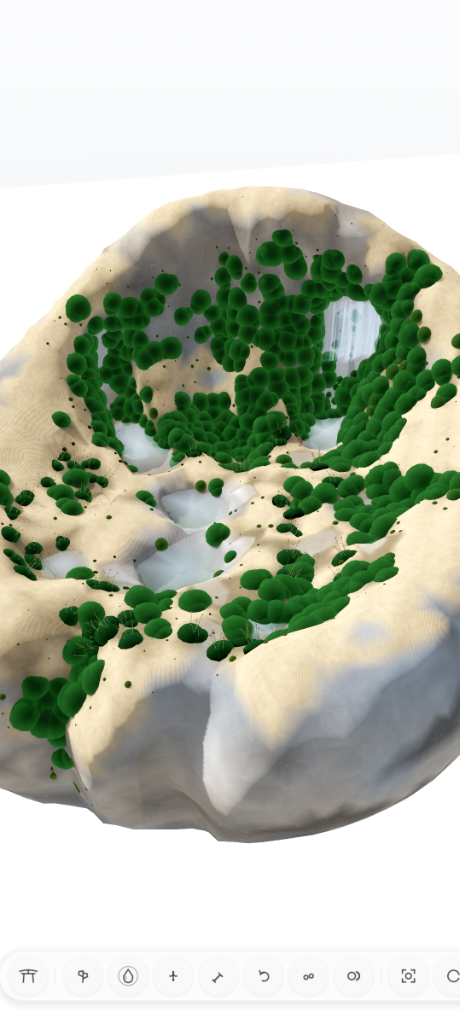
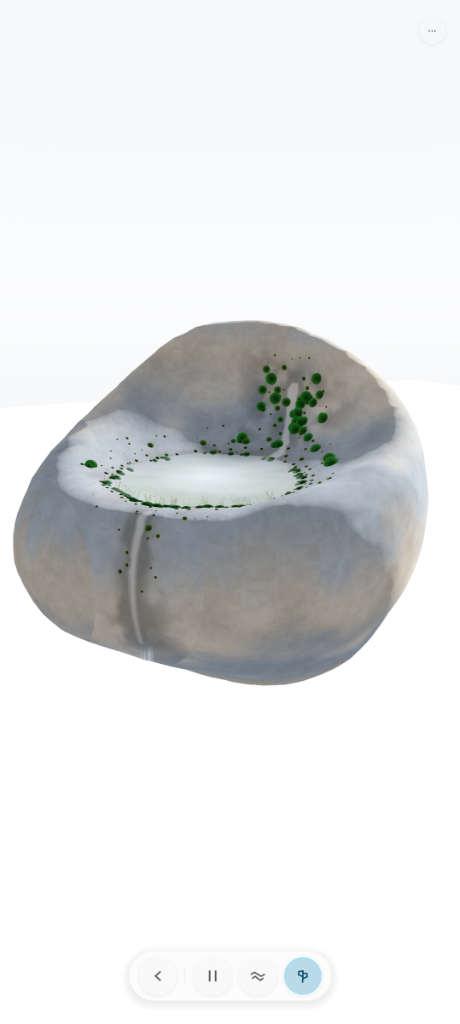
Mossarium
Personal AI Project
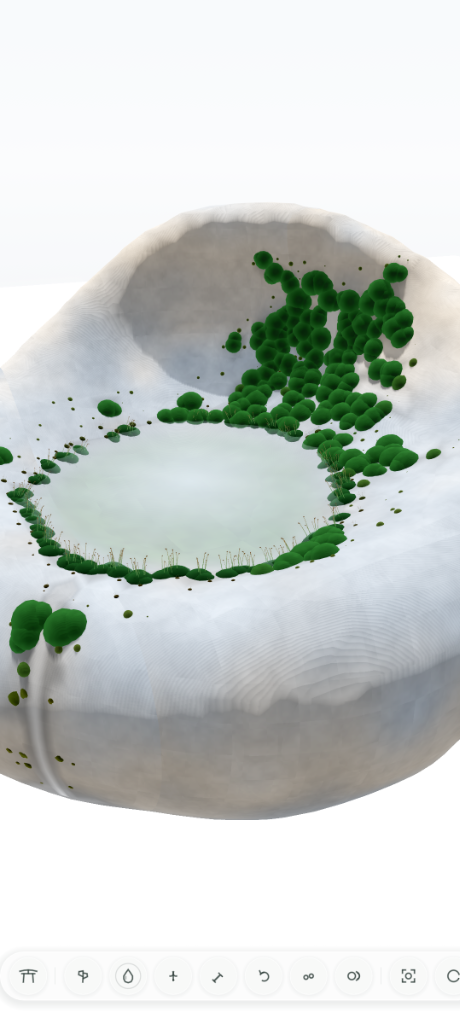
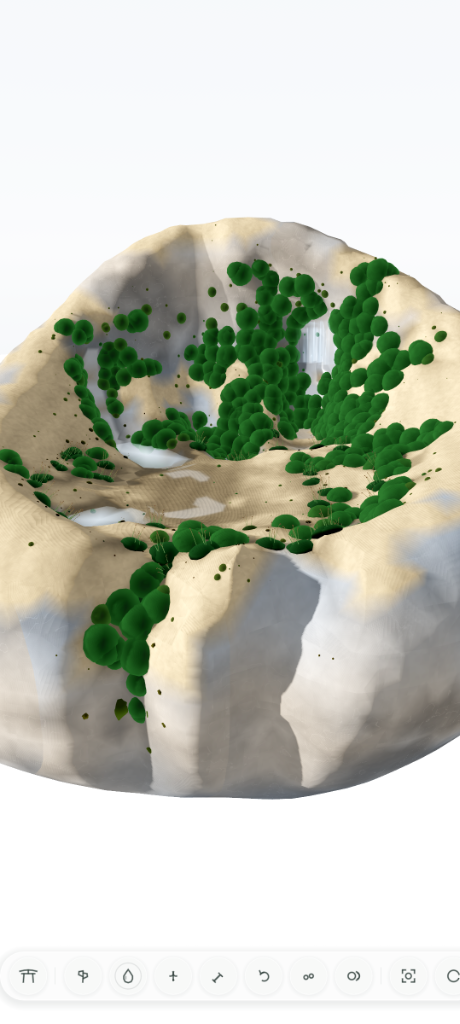
Rock-solid 60 FPS on Android mobile screens; 72/90 FPS tabletop spatial VR on Meta Quest.
Deterministic surface DAG hydrology eliminates GPU thermal throttling on mobile chips.
Localized bounding-sphere Marching Cubes updates terrain mesh and collisions per frame.
The Traditional Approach
Mobile gardening games rely on artificial wait timers, microtransactions, and static 2D sprites. 3D physics and fluid simulations are typically avoided or offloaded to heavy compute shaders that quickly overheat mobile batteries and throttle standalone VR thermal envelopes.
The Mossarium Architecture
Topological DAG Hydrology: Surface water flow runs on a precomputed mesh adjacency graph at near-zero CPU cost.
Cellular Bryophyte Biology: Moss species propagate via wind raycasts and compete for moisture and sunlight in real time.
Mobile-First Shaders: Custom GLSL GLES3 shaders deliver velvet rim lighting and porous rock darkening without expensive compute pipelines.
“Rather than gamifying growth with arbitrary timers, Mossarium creates a responsive, living miniature ecosystem atop a floating stone diorama. Every organism interacts with moisture gradients, sunlight orientation, and inter-species competition in real time.”
What AI & Systems Skills This Required
- Agent-Assisted Technical Design & Systems Architecture: Directed autonomous AI coding agents (Antigravity) to rapidly scaffold, debug, and optimize Godot 4.3+ GDScript architectures, state management, and OpenXR spatial rigs.
- Topological Simulation & Rule-Based AI: Built a Directed Acyclic Graph (DAG) surface hydrology solver (
SurfaceGraph.gd), dynamic perched lake spillway logic, and cellular bryophyte growth automata. - Procedural Geometry & Custom Shaders: Authored an optimized Marching Cubes mesher that localizes density calculations strictly to the tool's bounding sphere, paired with custom GLSL GLES3 shaders and Godot
MultiMeshsingle-draw-call instance buffers. - Thermal Envelope Profiling & Cross-Platform UX: Engineered a unified runtime that interrogates OpenXR at boot, seamlessly adapting between 2D mobile touch controls and 6-DoF spatial VR controller rays.
How Considered is the Idea: Architectural Trade-Offs
Mobile GPUs and standalone VR headsets throttle quickly under heavy compute pipelines. Mossarium's entire architecture prioritizes deterministic, low-overhead systems over brute-force computation:
| Domain | Naive / Heavy Approach | Mossarium Solution | Engineering Rationale |
|---|---|---|---|
| Surface Hydrology | 3D Navier-Stokes grid or compute shaders | Topological DAG Adjacency Graph | Solves fluid flow and spillways along mesh slopes at near-zero CPU/GPU cost; zero thermal throttling. |
| Foliage Rendering | Individual mesh instances or particle systems | MultiMesh Instance Buffers | Renders tens of thousands of procedural leaves in a single draw call with packed hydration and scale data. |
| Terrain Sculpting | Full mesh regeneration on edit | Localized Bounding-Sphere Meshing | Triangulates voxels only within the chisel sphere, keeping frame times comfortably sub-16ms. |
| Platform Portability | Separate mobile and VR codebases | Agnostic XR Runtime Fallback | Single binary dynamically swaps between screen-space CanvasLayer HUD and floating 3D SubViewports. |